The Vietnamese Government is
introducing a project to try to reduce the risk of rabies in the country through
much stricter dog control. Although I agree, of course, with their effort to
reduce this fatal disease, the wording in the report I read (here) implies that
all dogs must have an owner and that any stray or street dog should be caught
by local authorities and euthanized if not claimed within 72 hours.
Unless all unowned dogs are
removed, which is very unlikely to be achieved, then removing some from the
streets may actually make the situation worse by encouraging movement within
the wider dog population as dogs from elsewhere wander into dog-free areas. In
this way the rabies virus itself becomes more mobile. A far better tactic is
vaccination, which also happens to leave the traditional unowned village dog
lifestyle intact.
When it comes to stray dogs there
is far too much over-reaction and far too many misdirected, overly ambitious showcase
projects.
 |
| Learn more about the lives and issue of unowned dogs in my e-book ”A Stray View” available from Bangkok Books (readable as .pdf on any computer) |

Thursday, November 29, 2012
Reducing Rabies in Vietnam or Not?

Tuesday, November 27, 2012
Indian Stray Dogs at University
Seeing stray dogs as individuals with
personalities makes a real difference to their relationship to the people
around them. The Hindu newspaper has published a story (here) about how the
stray dogs at Jadavpur University in India are part of the community to the
extent that some even attend lectures (more often than some students
apparently). They also have their own Facebook page (JUDogs) run by a group of
lecturers and students who take responsibility for their care and other dog
welfare issues in the area.
What comes across to me is how these people appreciate the individual
personalities of the dogs, and more and more I feel that this is a crucial
connection lacking in too many situations where human residents and unowned
dogs fail to live together peacefully. Remaining as strangers is far more
likely to lead to tension than getting to know eachother. The urban environment
isn’t always conducive to friendliness but I don’t believe it has to be that
way and a more caring community attitude undoubtedly has other benefits.
It’s great to see a story like
this from India that highlights the positives about having unowned dogs around
to balance all the daily “dog menace” stories.
|
| Learn more about the lives and issue of unowned dogs in my e-book ”A Stray View” available from Bangkok Books (readable as .pdf on any computer) |
Solving a Seychelles Stray Dog Problem Humanely
In response to unowned dogs
roaming the Seychelles Bird Sanctuary and “wreaking havoc on the birds”, one
man took a very humane approach to solving the problem (full story here).
Nature Seychelles Chief Executive, Nirmal Shah, befriended the dogs and started
feeding them outside the sanctuary at Nature Seychelles headquarters. By doing
so the dogs no longer disturbed the birds and the office compound acquired
“excellent guard dogs”. This informal adoption has proved very successful but as
the dogs are abandoned pets he is also trying to reduce the long-term problem
through campaigning against discarding pets and also accepts that this approach
would not work in all situations.
|
| Learn more about the lives and issue of unowned dogs in my e-book ”A Stray View” available from Bangkok Books (readable as .pdf on any computer) |
Friday, November 23, 2012
Handicapped Stray Dog Video
This video of a stray dog in
China which has paralysed back legs but still manages to get around by walking
with a “hand-stand” has been posted on Youtube several times and on different
blogs many more times. Information about the animal is very sparse and I have
not seen any details about how it came to be in this condition but a traffic
accident would be a good guess.
I wasn’t going to post the video
myself until I started reading some of the on-line comments, which are largely
anti-Chinese and either make weak jokes about nobody wanting to eat such an
animal or berate the Chinese in general for not adopting the dog as a pet.
However, the fact that a dog with
such a handicap can so confidently walk around in this manner and actually look
reasonably well-fed suggests to me that it is actually being looked after to
some extent but in east Asian culture that does not necessarily mean as a pet.
Rather than wondering why nobody has adopted this poor dog perhaps we should be
wondering how it is able to carry on living on the streets without being adopted. It
could well be a case of care in the community that would never happen in the
societies providing the anti-Chinese comments.
|
| Learn more about the lives and issue of unowned dogs in my e-book ”A Stray View” available from Bangkok Books (readable as .pdf on any computer) |
Thursday, November 22, 2012
Cambodian Street Dogs
Here is a blog post about street
dogs in Phnom Penh, Cambodia, by two backpackers travelling during their gap
year. They have posted a good range of photos showing a variety of dogs, which
are worth a look.
What I found particularly
interesting was the picture of dalmatians with the comment about them being
some of the scariest dogs they had come across and how they were “glad they
were tied up”. These are very obviously pets and to me it is absolutely no
coincidence that they were the nasty ones. Pets are socialised to people and
react to human strangers as they would react to canine strangers i.e. by
confronting them. Village dogs generally have a more balanced view of their
relationship to people.
In countries with both pets and native
streets dogs, time and again an open mind can see that pets are typically far
more aggressive towards people than are dogs born to the streets. The problem
is that most people do not realise that the dog snarling at them is actually a
pet dog on the loose and thereby the generic idea of “street dogs” unfairly gets a bad name.
|
| Learn more about the lives and issue of unowned dogs in my e-book ”A Stray View” available from Bangkok Books (readable as .pdf on any computer) |
Monday, November 19, 2012
StreetView Street Dogs
Inspired by a story about a
rescued street dog in California that could be seen on Google StreetView
(here), I had a wander around some of the streets of Bangkok on StreetView to
see what I could find. Here are a few of the results:
   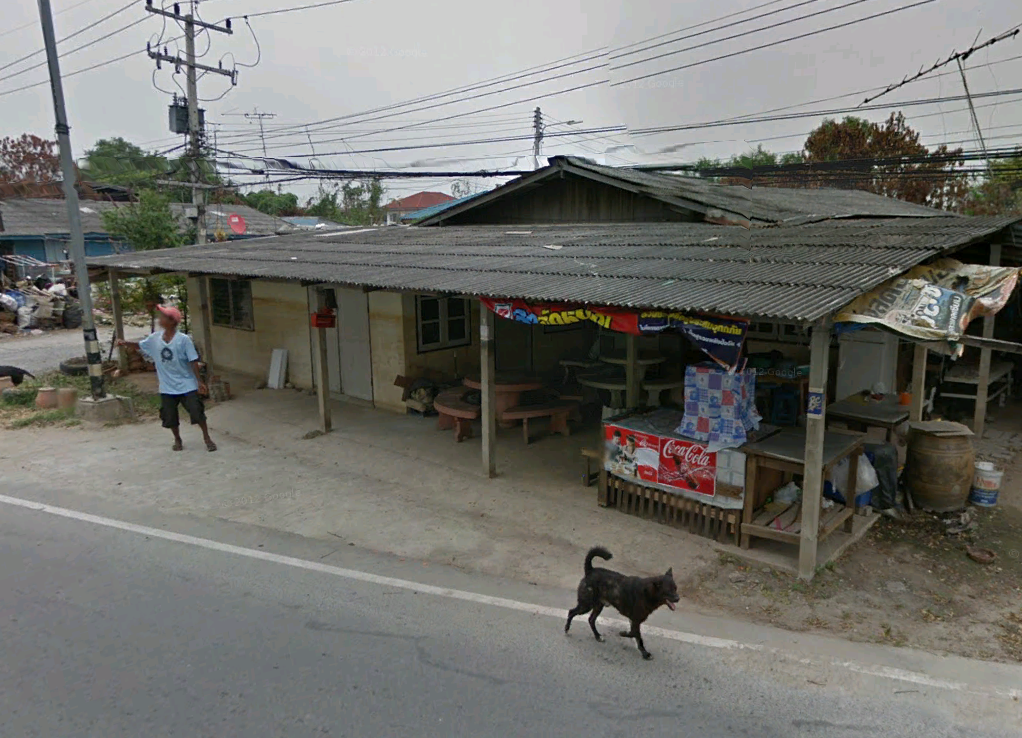 
© 2012 Google
© 2012 Tele Atlas
Then I had a quick look at where
I used to live in Chiang Mai in the north of Thailand where street dogs were
also quite easy to spot:
  
© 2012 Google
© 2012 Tele Atlas
Popping over to Mexico City I
found fewer than I expected but in the right places where people gather and
hang around there were also dogs:
    
© 2012 Google
© 2012 INEGI
Finally, on this quick tour I
went to Moscow where there have been numerous stories in the recent past about
the reported 30,000-35,000 stray dogs in the city. I spent about half an hour
wandering around on StreetView but couldn’t find any of them. Interestingly,
although I saw plenty of people walking about in pleasant weather I didn’t even
see a pet dog on a leash.
Of course, this doesn’t mean very much but does highlight
to me that life for street dogs in different cities can mean very different
things. In Thailand (and perhaps Mexico) they are accepted and live as an
integral part of the urban community but in Moscow they seem to have to lead
more furtive lives which is inevitably harder particularly given the harsh
climate.
|
| Learn more about the lives and issue of unowned dogs in my e-book ”A Stray View” available from Bangkok Books (readable as .pdf on any computer) |
Subscribe to:
Posts (Atom)